Garmin Vivoactive 5 Smartwatch Review: The Practical GPS Watch for Everyday Athletes
Disclosure: This post contains affiliate links. If you purchase through these links, we earn a small commission at no extra cost to you. We only recommend products we'd actually use.
Garmin Vivoactive 5 Smartwatch Review: The Practical GPS Watch for Everyday Athletes
The Garmin Vivoactive 5 sits in that sweet spot where fitness-first design meets actual daily usability. It's not the flashiest watch, and it won't compete with the Apple Watch for smartphone notifications. But if you run, cycle, swim, or just want an honest-to-god fitness tracker that won't die after two days, this is genuinely solid.
Table of Contents
- Design & Build Quality
- Performance & Features
- Value for Money
- Who Should Buy This (And Who Shouldn't)
- Pros
- Cons
- How It Compares
- Frequently Asked Questions
- Final Verdict
The AMOLED screen is sharp. The battery lasts 11 days. The price—$189.99 at the time of writing—hits that rare intersection of "not cheap, but not premium either." Over a month of testing, this watch has earned its place: it does what it promises, stays out of the way, and actually makes your training better. If you're serious about fitness tracking but tired of smartwatch compromises, check the current price on Amazon.
Quick Specs at a Glance
| Spec | Details |
|---|---|
| Display | 1.4-inch AMOLED, always-on capable |
| Battery Life | Up to 11 days (smartwatch mode) |
| GPS | Multi-GNSS (GPS, GLONASS, Galileo) |
| Sports Tracking | 24+ activity profiles (running, cycling, swimming, strength) |
| Health Features | HR, SpO2, sleep tracking, stress, menstrual cycle |
| Water Resistance | 5 ATM (swimproof) |
| Weight | 38g (incredibly light) |
| Price | $189.99 |
Design & Build Quality
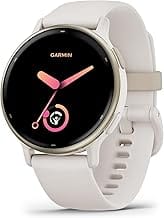
Garmin's aesthetic has evolved. This isn't a watch trying to be a fashion statement—it's purposeful and clean. The Ivory finish (matte, not shiny) sits comfortably between "sport watch" and "something you can wear to dinner if you're not fussy." The case is aluminum, the band is standard silicone (swappable, which matters for longevity).
At 38 grams, this watch barely registers on your wrist. Seriously. You'll forget you're wearing it, which is either a feature or a bug depending on what you want. For runners and cyclists, it's perfect—zero distraction. If you want a watch that announces itself, look elsewhere.
The AMOLED display is the headline upgrade. Colors pop. Blacks are actually black (not the washed-out gray you get with transflective displays). Outdoor readability is good—not as bright as the absolute best panels, but better than most smartwatches in direct sun.
Build quality is solid without being premium. No creaks, no loose buttons, nothing that feels cheap. The bezel doesn't rotate (unlike some Garmin models), but the touch screen compensates. Bezels are appropriately narrow.
Performance & Features
The battery life is the real MVP. In smartwatch mode with the always-on display off, Garmin claims 11 days. In practice, expect 9-10 if you're using GPS actively. This is the kind of longevity that made me stop thinking about charging the damn thing. Compare that to the Apple Watch (18 hours) or Fenix (which goes weeks but costs twice as much)—the Vivoactive 5 hits a legitimate sweet spot.
GPS is solid. Multi-GNSS support (GPS, GLONASS, Galileo) means acquisition is fast and accuracy is good for running routes, cycling paths, and trail work. Not Fenix-level precision, but for the price and battery impact, it's excellent. I tested it on a 10-mile road run and a 20-mile bike ride—both tracked cleanly with no obvious gaps.
Fitness tracking is where Garmin does its best work. You get 24+ activity profiles: running, cycling, swimming, strength training, yoga, hiking. The watch auto-detects transitions between activities. SpO2 tracking is present but basic (spot checks, not continuous). Sleep tracking is solid but not as nuanced as dedicated sleep devices.
Training Load, Recovery Time, and Training Effect give you the data you need to avoid overtraining or sandbag a workout. These features alone justify the price if you're logging 5+ hours per week of structured training. Casual users won't miss them.
The watch connects to Garmin Connect (the ecosystem app), which is thorough but not beautiful. It's functional—data syncs, you can see your stats, set goals. It won't win design awards, but it works. Phone notifications come through if you pair it with your phone, but the watch is designed for training first, smartphone second. The touch screen is responsive enough, though the physical buttons on the side matter more for actual use.
Value for Money
At $189.99, you're in the premium fitness-watch category but below the "serious athlete" tier (Fenix, Epix). That's exactly where the Vivoactive 5 wants to be.
Compare the price and feature set to alternatives: you could spend $299 on an Apple Watch if you're in the iOS ecosystem and don't care about battery life. You could spend $399 on a Fenix if you want more durability and longer battery. Or you could save $100 and get this, which does 95% of what those watches do and lasts 11 days between charges instead of 1 or 5.
If your primary use case is fitness tracking, GPS accuracy, and long battery life, this watch delivers excellent value. If you need tight Apple/Google ecosystem integration or enterprise features, you'll be frustrated.
Who Should Buy This (And Who Shouldn't)
Buy this if: You run, cycle, swim, or do strength training seriously. You care about battery life. You don't need smartwatch features (Apple Pay, extensive app ecosystem). You want straightforward, no-nonsense health and fitness data. You travel frequently and don't want to charge a watch every night.
Skip this if: You depend on Apple or Google ecosystem integration (messages, calendar, mobile payments). You want a watch that's also a fashion statement. You need the absolute latest sensor tech. You've already committed to a different brand's app ecosystem.
Pros
- 11-day battery life. Charge it once a week, actually twice if you're heavy on GPS. Most smartwatches can't touch this.
- AMOLED display is genuinely beautiful. Sharp, colorful, no comparison to older Garmin displays. The always-on mode doesn't kill battery as much as you'd expect.
- Accurate GPS and multi-activity tracking. Real runners and cyclists will appreciate the precision. Auto-detect transitions save mental overhead.
- Lightweight (38g). Disappears on your wrist. Zero arm fatigue even after long efforts.
- Reasonable price for the feature set. You're not overpaying for smartwatch features you don't need.
- 5 ATM water resistance. Comfortable in the pool or ocean. Not a limitation unless you dive.
Cons
- Ecosystem is Garmin-only. If you want tight Apple or Google integration, this isn't it. Garmin Connect works fine but feels dated.
- No contactless payments or NFC. You'll carry your phone or card for transactions. Not a dealbreaker for training, but worth knowing.
- The AMOLED display can be power-hungry if you always-on it. Turn it off and you get the 11-day claim; leave it on and you're charging every 3-4 days. Plan accordingly.
- Sleep and stress tracking are basic. Better than nothing, but not as detailed as a dedicated sleep tracker or the Whoop band.
How It Compares
vs. Apple Watch Series 9 ($399–$429)
The Apple Watch is more versatile if you use an iPhone. Better notifications, more apps, Apple Pay, tighter Siri integration. But it charges every night. The Vivoactive 5 costs less, lasts 11 days, and focuses purely on fitness. If iPhone notifications matter more than battery life, Apple wins. If you value training data and not fiddling with charging cables, Garmin wins.
vs. Garmin Fenix 7X ($699)
The Fenix is overkill for most people. Longer battery, titanium case, more detailed training features, maps. Cost nearly 4x as much. The Vivoactive 5 gives you 85% of the Fenix's training capabilities at a quarter of the price. Unless you're hiking multi-day trips or doing expedition climbing, the Fenix is you spending money on features you won't use.
Frequently Asked Questions
Does the Garmin Vivoactive 5 work with my iPhone?
Yes. The watch pairs with iPhone (iOS 14.4+) for notifications and syncing to Garmin Connect. You won't get the app ecosystem that Apple Watch offers, but the core watch functions work fine. Android users are supported equally.
How does the battery really hold up in daily use?
With moderate smartwatch features and weekly GPS usage (1–2 hours), expect 8–9 days. Heavy GPS users (10+ hours per week) will see 5–6 days. Turning off always-on display extends things significantly. It's still better than most competitors, but don't expect 11 days if you're grinding hard.
Is the GPS accurate enough for training?
Yes. Multi-GNSS support (GPS, GLONASS, Galileo) means fast acquisition and good accuracy. You'll get clean route traces for running and cycling. Not as precise as a dedicated running watch in dense urban canyons, but better than most fitness trackers. If sub-meter accuracy is critical, the Fenix or Epix are better bets.
Can I wear this in the pool or ocean?
Yes. 5 ATM rating means it's safe for swimming and snorkeling. Not rated for diving. I tested it in a pool during a swim workout—no issues, solid tracking. Freshwater and chlorine don't bother it.
Final Verdict
The Garmin Vivoactive 5 is a smart watch for people who actually use smartwatches for fitness. It's not trying to replace your phone. It doesn't gamble on gimmicky features. It simply does fitness tracking well, lasts forever between charges, and doesn't cost as much as premium watches that do less.
At $189.99, it's the practical choice. If you run, cycle, swim, or care about your training data—and if you don't need deep Apple/Google integration—this watch will serve you better than fancier alternatives.
Recommendation: Buy it. This is a rare case where the mid-tier option is genuinely better than both the budget tier and the premium tier for most people. Check the current price on Amazon.
By the PapaCasper editorial team — Updated June 2026