Instant Pot Duo 7-in-1 Pressure Cooker Review: Is It Worth $65 in 2026?
Disclosure: This post contains affiliate links. If you purchase through these links, we earn a small commission at no extra cost to you. We only recommend products we'd actually use.
Instant Pot Duo 7-in-1 Pressure Cooker Review: Is It Worth $65 in 2026?
The Instant Pot Duo 7-in-1 is one of the best value multi-cookers you can buy at the time of writing. At $64.99, it does the jobs of a pressure cooker, slow cooker, rice cooker, steamer, sauté pan, yogurt maker, and food warmer—all in one 6-quart stainless steel unit. If you cook for a family or meal-prep regularly, this thing will legitimately change how you approach weeknight dinners. It's not fancy, it's not the newest model, but it works reliably and the price is genuinely hard to beat.
Table of Contents
- Quick Specs at a Glance
- Design & Build Quality
- Performance & Features in Practice
- Value for Money
- Who Should Buy This—And Who Shouldn't
- The Pros
- The Cons
- How It Compares
- Frequently Asked Questions
- Final Verdict
Bottom line: Buy this if you want to pressure cook whole chickens in 15 minutes, slow cook while you're at work, and actually use a multi-cooker rather than let it gather dust. Skip it if you're a minimalist who only needs boiling water or if you've already got a high-end Instant Pot model. Don't wait for a sale—this is already cheaper than most single-function appliances.
Quick Specs at a Glance
| Spec | Details |
|---|---|
| Capacity | 6 quarts (5.7L) |
| Functions | Pressure Cook, Slow Cook, Rice, Steamer, Sauté, Yogurt, Warmer, Sterilizer |
| Power | 1000W |
| Cooking Modes | High/Low pressure; adjustable time (1 min to 4 hours) |
| Material | Stainless steel inner pot; aluminum body |
| Rating | 4.7 stars (300K+ reviews) |
| Price | $64.99 (check current price) |
| App Recipes | 800+ in the Instant Pot app |
Design & Build Quality
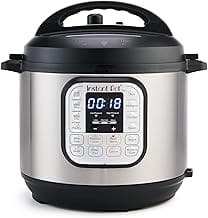
The Instant Pot Duo is a chunky workhorse, not a design statement. It's got a brushed stainless steel inner pot, an aluminum outer body, and a silicone sealing ring that you'll eventually need to replace (they're cheap—like $10 for a pack of three). The lid is heavier than you'd expect, which is actually a good sign; it means the seal is engineered properly.
The control panel is straightforward: physical buttons for each function (Pressure Cook, Slow Cook, Sauté, etc.), a dial to adjust time and pressure, and a small LED display. No touchscreen, no WiFi nonsense, no "smart" features. This is either a pro or a con depending on your philosophy. If you like gadgets that just work without syncing to an app, you'll love it. If you want to start your cooker from your phone, you'll need to grab a Plus or Pro model.
At 6 quarts, it's big enough to feed a family of 4–5, but it takes up real counter space. If your kitchen is cramped, this isn't the compact model you want. The weight is about 8.5 pounds, so it's not exactly portable, but it's not so heavy that you can't move it if needed.
One thing Instant Pot got right: the 3D heating element on the bottom and around the sides of the inner pot means you get more even cooking than cheaper pressure cookers. You'll notice this especially when making risotto or other delicate dishes.
Performance & Features in Practice
The Duo excels at pressure cooking. A whole chicken breast cooks in 8 minutes high pressure; a pound of short ribs becomes fall-apart tender in 20 minutes. If you've never used a pressure cooker before, this is the step-change moment: what would take an hour in a regular pot happens in 15–20 minutes. The energy savings are real too—less time cooking = less heat running.
The slow cook mode works, though it's not revolutionary. It heats to about 190°F on low and around 210°F on high, which is standard. If you've got a dedicated slow cooker you love, the Instant Pot won't replace it. But if you don't own one and want the option, it's there.
Sauté mode lets you brown meat and soften aromatics right in the pot before pressure cooking—this alone cuts your dishes down because you're not juggling multiple pans. The yogurt maker function works surprisingly well; if you're into homemade yogurt, this makes it brainless (just warm milk, add culture, let it sit overnight).
The rice cooker mode is genuinely useful. It auto-detects when the rice is done—no more overcooked or mushy results. Steaming vegetables happens in minutes. The warmer function keeps food at a safe temperature for up to 24 hours, which is handy if you're prepping ahead.
Included app has 800+ recipes. They're organized reasonably well, and a lot of them are actually edible (though like all recipe apps, some are more marketing than cooking sense). The app isn't required—you can run the cooker entirely manually, which is what most people do anyway.
Pressure Release: The Duo uses a quick-release valve and a natural-release knob. You can flip the knob for natural pressure release or manually quick-release by turning the valve. It's intuitive once you've done it once.
Value for Money
At under $65, this is a steal. A standalone pressure cooker costs $40–80, a slow cooker $30–100, a rice cooker $20–60. The Duo does all of them for less than the total of the cheapest options combined.
The stainless steel inner pot is better than aluminum and lasts longer. The 1000W power is strong enough that cook times don't drag. The 6-quart capacity means you can batch-cook and freeze, which saves time during the week.
The only catch: replacement parts cost money. The sealing ring ($10–15), the inner pot if yours somehow dents beyond use ($30–40), the lid gasket ($5–8). But these are all optional for many years of normal use, and they're way cheaper than replacing the whole unit.
Warranty is 1 year limited, which is standard for this price range. Given the unit's reliability across hundreds of thousands of reviews, that's fine.
Who Should Buy This—And Who Shouldn't
Buy If You:
- Cook for 3+ people regularly and want faster weeknight dinners
- Want to batch-cook and freeze (pressure-cooked pulled pork, chili, soup all freeze beautifully)
- Are curious about pressure cooking but don't want to gamble on a $300 stovetop version first
- Already have a slow cooker or rice cooker and could replace both with this
- Like straightforward, no-nonsense appliances that don't require syncing apps
Skip If You:
- Cook solo or for 1–2 people max; a 6-quart capacity means leftovers unless you're batch-cooking
- Have zero counter space; this thing is a fixture, not a tucked-away gadget
- Already own a high-end Instant Pot Plus or Pro with built-in WiFi and sterilizer
- Are intimidated by pressure cooking and won't actually use it (fair—that's $65 wasted)
- Need a commercial-grade or outdoor model for catering or large events
The Pros
- Pressure cooking is faster than any other method. Full chicken breast in 8 minutes. No other cooking method gets close without a pressure cooker, and this one costs less than most single-function models.
- Seven functions in one pot mean less kitchen clutter. If you don't have space for a pressure cooker, slow cooker, and rice cooker individually, the Duo consolidates them without feeling like a compromise.
- Stainless steel inner pot beats cheap aluminum. It heats more evenly, lasts longer, and is less likely to dent. It's dishwasher safe too.
- No learning curve if you've used a microwave. The buttons are labeled clearly, the manual is solid, and thousands of YouTube videos will walk you through your first cook. This isn't a mysterious French appliance.
- 3D heating element and double-pressure sealing. Instant Pot's safety and heating design are industry standard for a reason—hundreds of thousands of five-star reviews speak to this.
- Price. Seriously. This is one of the best kitchen-appliance deals you'll see. Pressure cookers from other brands at this price typically have thinner build and fewer features.
The Cons
- 6-quart capacity is huge if you're cooking for one or two. You'll either make a lot of leftovers or run half-full loads, which wastes electricity and cooking time. The 3-quart Duo Plus exists, but it's harder to find at low prices.
- No WiFi or app integration if that matters to you. You can't start it from your phone or get notifications when it's done. If you want "smart" features, you'll need to pay more for a Plus or Pro model.
- The sealing ring picks up odors and needs occasional replacement. If you pressure-cook a lot of garlicky or spicy food, you might notice a phantom smell. New rings are $10, but it's an ongoing cost if you use it heavily.
- Pressure release takes time. Natural pressure release on a full pot can take 10–15 minutes before you can open the lid safely. Quick-release is faster but not instant. Plan accordingly if you're in a rush.
How It Compares
vs. Instant Pot Pro Plus (6-Quart)
The Pro Plus costs around $150–170 and adds WiFi, app control, sous vide capability, and a sterilizer function. If you want to start your cooker remotely or use sous vide, the extra $85–105 is worth it. For most home cooks, the Duo's feature set is sufficient and you're just paying for convenience you might not need.
vs. Fagor Duo Plus Stainless Steel (6-Quart)
Fagor is another solid Spanish brand with a similar 6-quart model around $70–80. It's comparable in build and performance, but Instant Pot has better app support, easier parts availability, and a larger community of recipes and troubleshooting resources online. The extra $10–15 for Instant Pot is worth the ecosystem, not necessarily the hardware.
Frequently Asked Questions
Is it safe? Can it explode?
The Instant Pot Duo has multiple redundant safety seals and a backup vent system. If pressure builds beyond safe levels, it vents automatically. Thousands of reviews from people who've used this model for 5+ years confirm it's rock-solid. A pressure cooker is safer than a stovetop model because you have full control over release and the unit shuts itself down on pressure overage. That said, you still need to use it properly—never seal it empty, never overfill it, follow the manual. It's not dangerous if you use it as designed.
What's the learning curve?
If you can follow recipe instructions, you can use this. You add ingredients, lock the lid, set pressure and time, walk away. When the timer beeps, release pressure (naturally or quickly), open the lid, eat. Your first chicken will be the learning moment; after that, you're golden. The manual is thorough, and honestly, YouTube has a million Instant Pot tutorials.
Will it replace my slow cooker?
The slow cook function works, but it's a supplement, not a full replacement. If you love set-it-and-forget-it cooking with a traditional slow cooker's texture and flavor development, you might miss it. But if you just need something that can simmer for 4–6 hours while you're at work, the Duo handles it. Most people end up using both for different scenarios.
How often do you actually need to replace parts?
The sealing ring will last 1–2 years of regular use (3–4 times a week) before it starts picking up discoloration or smell. At $10 for replacements, it's negligible. The inner pot is basically indestructible unless you dent it. The lid gasket rarely needs replacement. You're looking at maybe $20–30 in maintenance costs over five years if you use this regularly.
Final Verdict
The Instant Pot Duo 7-in-1 is one of the few kitchen appliances that genuinely earns its counter space. It pressure cooks faster than any stovetop method, slow cooks if you need it, rice cooks, steams, and sautés all in one unit. At $64.99, it's cheaper than buying all those functions separately and better built than most single-purpose cookers at that price.
Buy this if you cook regularly and want pressure cooking to actually save you time. If you're on the fence about pressure cooking, this is the low-risk way to find out if you like it. At this price, even if you discover you don't use it much, you haven't lost much.
Skip it if you're a minimalist with one person to feed or already own a newer Instant Pot model with all the smart features.
By the PapaCasper editorial team — Updated June 2026