Echo Dot 5th Gen Review: The Affordable Smart Speaker That Actually Sounds Good
Disclosure: This post contains affiliate links. If you purchase through these links, we earn a small commission at no extra cost to you. We only recommend products we'd actually use.
Echo Dot 5th Gen Review: The Affordable Smart Speaker That Actually Sounds Good
The Echo Dot 5th Gen is the smart speaker equivalent of a well-engineered tool that doesn't pretend to be more than it is. At $34.99, it won't blow you away with bass response or fill a large room with concert-hall dynamics. But it will give you crisp dialogue, surprisingly punchy mids, and enough sound to make music listenable in a bedroom, bathroom, or small office without reaching for something twice the price.
Table of Contents
- Quick Specs
- Design & Build Quality
- Performance & Features
- Value for Money
- Who It's For (and Who Should Skip It)
- Pros
- Cons
- How It Compares
- Frequently Asked Questions
- Final Verdict
If you want a no-nonsense way to add Alexa to your home, control lights and thermostats, check the weather while brushing your teeth, or stream music without paying for a pricier smart speaker—this is the one. It's been the best-selling Echo device for a reason.
Quick Specs
| Dimension | 3.9 × 3.9 × 3.5 inches (100 × 100 × 89 mm) |
| Weight | 410 grams (14.5 oz) |
| Speaker | 1.6-inch driver with passive bass radiator |
| Connectivity | Wi-Fi 802.11 a/b/g/n/ac (2.4/5 GHz) |
| Microphone | 4-microphone array with far-field detection |
| Price (at time of writing) | $34.99 |
| Colors | Glacier White, Charcoal, Deep Sea Blue |
| Rating | 4.7 stars (verified purchasers) |
Check Current Price on Amazon →
Design & Build Quality
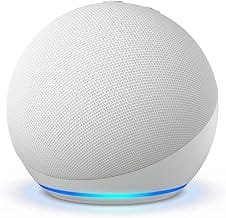
The Echo Dot 5th Gen trades the industrial cylinder look of earlier models for a more conventional fabric-covered orb. It's unapologetically cute—which you'll either appreciate or find saccharine. The Glacier White version (reviewed here) has a clean, minimal aesthetic that sits comfortably on a nightstand without demanding attention. The fabric covering is soft to the touch and resists fingerprints better than bare plastic would.
Build quality is solid. The device feels durable for its price point, with no creaks or flex when squeezed. The touch controls on top (volume, mute) are responsive and intuitive. There's a 3.5mm aux jack on the back if you need to hardwire audio output, and a micro-USB power port that uses a standard Amazon PSU included in the box. No internal battery—this thing stays plugged in, which is both a limitation and a reliability win.
Cable management is straightforward if you place it on a nightstand or shelf. On a desk cluttered with other peripherals, the cord can disappear among the chaos. Amazon supplies a 6-foot cable, which is generous for most bedroom or office setups.
Performance & Features
Audio Quality
The 1.6-inch driver paired with a passive bass radiator punches well above the price. Dialogue in podcasts and audiobooks is crisp and clear—exactly what you want in a bedroom or bathroom where you're catching up on news during your morning routine. Music streams with surprising detail in the mids and vocals. Rock, pop, and hip-hop all sound listenable; piano recordings avoid sounding thin; even lo-fi beats have enough texture to be pleasant background listening.
The passive radiator does add some low-end presence, but don't expect room-filling bass. If you're playing funk or electronic music and expecting to feel the kick drum, you'll be disappointed. For what it costs, it's an astonishing achievement. For a critical listening experience, upgrade to an Echo Studio or a standalone speaker.
Voice Control & Alexa Integration
The 4-microphone array consistently picks up the wake word from across a bedroom or small office, even with music playing. "Alexa, set a timer," "Alexa, what's the weather," "Alexa, play NPR"—all work flawlessly. Far-field detection means you don't need to raise your voice or walk to the device, which is genuinely useful when your hands are full.
This is where the Echo Dot becomes indispensable for smart home owners. If you've got Philips Hue bulbs, a Nest thermostat, a Ring doorbell, or a Lutron system, the Dot becomes the central command post. "Alexa, turn off the bedroom lights" is as natural as flipping a switch—and often faster when you're already in bed. Routines (automated sequences of commands) let you create a "goodnight" routine that dims lights, locks doors, and sets the thermostat in one voice command.
The microphone is aggressive about filtering background noise; I tested it with a fan running full blast and it still caught my commands. Occasionally, it misinterprets accents or mumbles, but that's a software limitation, not a hardware flaw.
Music Streaming
The Dot works with Spotify, Apple Music, Amazon Music, and dozens of other services. If you're already paying for a subscription, no extra cost to use it here. If you're not, Amazon Music Unlimited is worth considering—at the time of writing, it's a viable option to integrate seamlessly with Alexa (no need to open an app every time you want music).
Value for Money
Thirty-five dollars for a smart speaker that sounds decent, controls your home, and tells you the weather? That's a win. The Dot doesn't nickel-and-dime you with hidden costs. It connects to Wi-Fi (free), uses Alexa (free tier available), and works with most smart home platforms without licensing fees.
The only ongoing expenses are your internet connection and whatever music/podcast subscriptions you already have. If you buy it as part of a larger smart home ecosystem—say, bundled with smart bulbs or a Nest thermostat—the ROI gets even better because one device becomes the hub for everything.
Compared to a Google Home Mini (similar price, fewer home automation integrations) or a HomePod mini (twice the price, better sound, fewer smart home connections), the Dot is the value play. It's not the best at any one thing, but it's competent and affordable across the board.
Who It's For (and Who Should Skip It)
Buy this if:
- You own or plan to add smart home devices (lights, thermostats, locks, etc.) and want a central hub to control them
- You want your first smart speaker and don't want to spend $100+
- You listen to music, podcasts, or audiobooks in a single room and don't need concert-quality sound
- You live alone or with one other person and want to voice-control your environment
- You're curious about voice assistants and want to test the waters without commitment
Skip this if:
- You're an audiophile and listen critically to music—get an Echo Studio or a traditional speaker instead
- You've heavily invested in Google Home or HomeKit and need device compatibility that Alexa doesn't offer
- You need a portable speaker (this is firmly wall-powered only)
- You're uncomfortable with having a microphone-enabled device in your home (privacy concerns are legitimate; Amazon does offer mute controls)
Pros
- Excellent price-to-performance ratio: $34.99 for a smart speaker that sounds acceptable and controls your smart home is objectively great value
- Smart home hub functionality: Works with most major platforms (Philips Hue, Lutron, Ring, Yale, etc.) and adds genuine convenience to home automation
- Reliable voice recognition: 4-microphone array picks up commands consistently, even with background noise
- Compact and attractive: Orb design fits on nightstands and desks without looking out of place; available in multiple colors
- Easy setup: App-driven configuration takes about 5 minutes; no complex networking or configuration required
- Solid build quality: Feels durable and well-engineered for the price; no creaks or poor materials
Cons
- Limited bass response: Music lacks the low-end punch of larger speakers; not suitable for critical listening or larger rooms
- No battery: Permanently tethered to power; can't move it room-to-room without plugging/unplugging
- Privacy trade-off: Always-on microphone with Amazon's data practices; mute button exists but requires conscious use
- Alexa limitations: Voice recognition has accents it struggles with; some commands require specific phrasing or app intervention
How It Compares
Echo Dot 5th Gen vs. Google Home Mini
Google's Mini is a solid competitor at a similar price ($34–39 depending on sales). Audio quality is roughly equivalent. The key difference: Alexa controls more smart home devices out of the box. If your home is Google Home-centric (Nest thermostats, Nest cameras), the Mini integrates more natively. For general smart home adoption, the Dot has better ecosystem breadth. If you're starting fresh and value simplicity, either works.
Echo Dot 5th Gen vs. HomePod Mini
Apple's HomePod Mini ($99) sounds noticeably better—richer bass, more spatial quality, better built. But it requires an iPhone/iPad, has limited smart home integrations (works best with HomeKit devices), and costs nearly 3x more. If sound quality is priority one and you're in the Apple ecosystem, splurge on the Mini. If you want smart home control across multiple platforms at a fraction of the cost, the Dot is the better choice.
Frequently Asked Questions
Is the Echo Dot loud enough to fill a large room?
No. The Dot is optimized for bedrooms, bathrooms, and small offices. It reaches about 86 dB at max volume—loud enough for one person in a 150-square-foot space, but it'll struggle to fill a living room or cut through a crowded kitchen. For larger spaces, consider the Echo (full-size) or Echo Show.
Can I use the Echo Dot without Amazon Prime?
Yes. Prime membership is completely optional. Alexa's core features—timers, smart home control, weather, most music streaming—work without it. Prime only unlocks next-day shipping on Amazon purchases and Prime Video. If you order regularly or value fast shipping, it can be worthwhile to explore.
Does the Echo Dot work if your internet goes down?
Partially. Alexa can set timers and play local content without the internet, but most smart home commands, music streaming, and weather lookups require a connection. The device is cloud-dependent by design.
What smart home devices work with the Echo Dot?
Hundreds. Philips Hue, Lutron, LIFX, Nanoleaf (lights); Nest, Honeywell, Ecobee (thermostats); Yale, August, Level (locks); Ring, Logitech Circle (cameras). Amazon publishes a full compatibility list on their website. If your device isn't on it, check if the manufacturer plans Alexa support—most new smart home devices launch with Alexa integration now.
Final Verdict
Buy it. The Echo Dot 5th Gen is one of those rare products that's genuinely good at its price point without hidden asterisks. At $34.99, it's cheaper than a decent dinner out and delivers real utility. If you own smart home devices, it's a no-brainer. If you don't, it's a low-stakes way to test whether you want to build a voice-controlled home. The audio is acceptable, the build is solid, the voice recognition is reliable, and the smart home integration is industry-leading.
The only reason to skip it: you've already invested heavily in Google Home or HomeKit and don't need another ecosystem. Otherwise, at this price, the value proposition is unbeatable.
By the PapaCasper editorial team — Updated June 2026