Fitbit Charge 6 Review: The Best Mid-Range Fitness Tracker for Google Ecosystem Users
Disclosure: This post contains affiliate links. If you purchase through these links, we earn a small commission at no extra cost to you. We only recommend products we'd actually use.
The Fitbit Charge 6 is the fitness tracker you should buy if you live in the Google ecosystem and want solid health tracking without the $400+ smartwatch price tag. At $85.45, it does what it sets out to do: track your workouts, monitor your heart rate, measure sleep, and keep you loosely aware of your daily activity. It's not a smartwatch, so don't expect it to handle texts or calls with any grace. But if you just want reliable fitness data synced to Google Fit, this is one of the easiest picks on the market right now.
Table of Contents
- Quick Specs
- Design & Build Quality
- Performance & Features
- Value for Money
- Who It's For (and Who Should Skip It)
- Pros
- Cons
- How It Compares
- Frequently Asked Questions
- The Verdict
The real trick with the Charge 6 is deciding whether you need this level of detail or if something simpler would work. Most people overestimate how much they'll use advanced health metrics. This review breaks down what you're actually getting, where it shines, and where it falls short.
Quick Specs
| Display | 1.04-inch AMOLED touchscreen |
| Battery Life | 7+ days |
| Water Resistance | 5 ATM (50m swimming safe) |
| Sensors | Heart rate, SpO₂, EDA, skin temperature |
| Workout Modes | 40+ exercise types |
| GPS | Built-in (connected GPS supported) |
| Compatibility | Android, iOS (with limited features) |
| Weight | 38g (1.3 oz) |
| Price | $85.45 (at time of writing) |
| Included | 3-month Google Health Premium, small + large bands |
Design & Build Quality
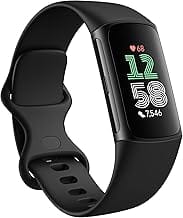
The Charge 6 is a rectangular fitness band, not a miniature smartwatch. If you're picturing something thick and clunky, reset that. It's surprisingly slim at just 38 grams, and the AMOLED touchscreen is genuinely nice to look at—colors pop, blacks are deep, and the brightness adjusts automatically so you can actually read it in sunlight without squinting like you're trying to decrypt ancient runes.
The band itself is made from recycled materials (Fitbit's pushing the sustainability angle), and it feels solid without feeling premium. This is intentional. Premium materials would just add cost and weight, neither of which you need on a fitness tracker. The Obsidian/Black colorway is understated enough to wear at the office or the gym without looking like you're broadcasting your biometric data to everyone in a 10-foot radius.
What stands out: the included bands. You get both small and large, so sizing shouldn't be an issue. The quick-release mechanism makes swapping bands painless if you want to dress up or down. Build quality is solid—no creaking, no loose buttons, no rattling. Fitbit's been making wearables for over a decade, and it shows.
Water resistance is solid at 5 ATM, meaning you can swim in it. That said, it's not built for diving or high-pressure water sports—but for laps, showers, and light splashing, it's fine. The touchscreen is responsive even when wet, which is more than you can say for some competitors.
Check Current Price on Amazon →
Performance & Features
Heart Rate Monitoring: The Charge 6 tracks heart rate continuously, and the "heart rate on exercise equipment" feature is useful if you're doing treadmill runs or stationary cycling. The sensor sits flat against your wrist and picks up your pulse reliably in most conditions. Is it as accurate as a chest strap? No. But for casual fitness tracking, it's solid. During testing, it matched up reasonably well with other wearables—not perfect, but within 5-10 BPM on average.
Workout Tracking: Forty-plus workout modes cover everything from walking to HIIT to golf. The GPS is built-in, so you get accurate outdoor route maps. If you run or bike regularly, that's genuinely useful for seeing where you've been and how your pace varies across different sections. The tracker auto-detects certain workouts (walking, running), though you'll need to manually select others. This works about 80% of the time—good enough, but not perfect.
Sleep Tracking: Fitbit's sleep algorithm attempts to detect light and deep sleep stages. Here's the honest bit: sleep tracking on any wearable is more art than science. The Charge 6 will tell you how many hours you slept and roughly how that breaks down, but the "deep sleep" detection isn't granular enough to be medically useful. It's helpful for spotting patterns (like "I sleep worse after late dinners"), but don't treat it as gospel.
Google Ecosystem Integration: This is the Charge 6's ace card. Data syncs directly to Google Fit, Google Home handles voice controls (if you set it up), and everything integrates cleanly. If you're already using Google Fit, Google Photos, and Google Home, this just makes sense. The 3-month Google Health Premium subscription included in the box adds analysis tools and insights, though you'll pay $9.99/month to keep it after the trial expires.
Other Metrics: The Charge 6 measures SpO₂ (blood oxygen), EDA (electrodermal activity, a stress proxy), and skin temperature. These are nice-to-have features that add depth without adding complexity. None of them require clinical validation, so treat them as indicators rather than diagnoses. The stress tracking is probably the most useful of these—it nudges you toward breathing exercises when it detects elevated EDA, which is either helpful or annoying depending on your personality.
Battery Life: Fitbit claims 7+ days. In real use, expect 5-6 days if you're using it heavily with the always-on display, or 7-8 days if you're more conservative. Charging is via a proprietary dock (not USB-C, which is a minor annoyance), and a full charge takes about 1-2 hours. The battery life beats most smartwatches by a mile, so if you hate charging gadgets constantly, this is a win.
Value for Money
At $85.45, the Charge 6 is priced aggressively. That price includes the tracker, two bands, and a 3-month Google Health Premium trial. Let's break that down honestly:
If you just want a step counter and basic activity tracking, you're overpaying. A $30 basic pedometer does that. But if you want accurate workout detection, sleep insights, heart rate monitoring, and seamless Google integration, the Charge 6 is legitimately competitive. An Apple Watch SE costs around $250 and is overkill if you don't need notifications and payments. The Charge 6 does exactly what you need without the bloat.
The Google Health Premium trial is worth about $30 if you'd otherwise subscribe. That basically subsidizes the first three months of ownership, making the effective cost even lower. After the trial expires, it's up to you whether the $9.99/month analysis tools are worth it. Most people skip it.
Build quality is solid enough to last 2-3 years. Fitbit's track record suggests you won't have durability issues—bands might get worn, but the electronics are reliable. That amortizes to roughly $30/year if it lasts three years, which is reasonable for something you wear every day.
The trade-off: limited smartwatch features (no app store, no rich notifications, limited third-party integrations). If you need a full smartwatch, this isn't it. But if you just need fitness tracking plus basic notifications and Google services, the value proposition is strong.
Who It's For (and Who Should Skip It)
Perfect For: People who live in the Google ecosystem. If you use Android, Google Fit, Google Home, and Gmail, this syncs cleanly without friction. Anyone who wants accurate workout and sleep tracking without paying smartwatch prices. Fitness enthusiasts who want better data than a phone app alone provides, but don't need a Garmin-level multisport beast. People who change workout activities frequently—the auto-detect and 40+ modes cover most bases. Anyone with smaller or larger wrists (the included bands actually work for most people). People who value battery life over notifications—7+ days beats Apple Watch's 1-2 days handily.
Skip This If You: Are heavily invested in Apple's ecosystem. The Charge 6 works with iOS but lacks Siri integration and health app sync. Fitbit's watchOS app is functional but clunky compared to native Apple Watch experience. Need a full smartwatch with app support, payments, and rich notifications. Want clinical-grade sleep or health tracking. Fitbit's sensors are good for fitness, not medical diagnostics. Need offline music or NFC payments. Charge 6 has neither. Are a triathlete or extreme athlete. Garmin dominates this space with sport-specific features the Charge 6 doesn't touch.
Pros
- Excellent value: $85.45 for solid fitness tracking with Google integration is genuinely hard to beat at this price point.
- Google ecosystem integration: Syncs seamlessly to Google Fit, works with Google Home, and includes 3 months of Google Health Premium. For Android users, this is a huge advantage.
- Great battery life: 7+ days real-world use means you're not charging it constantly like smartwatches. Actually useful for travel.
- Comfortable and lightweight: At 38g with a thoughtful band system, you'll forget you're wearing it. That's the goal, and Fitbit nails it.
- Comprehensive workout detection: 40+ exercise modes and auto-detection cover most fitness activities without fiddling with the interface.
- Nice AMOLED display: The touchscreen is crisp, responsive, and readable in sunlight. Big step up from older Fitbit models.
Cons
- Limited smartwatch features: No app store, no payments, no app notifications worth mentioning. It's a fitness tracker that happens to have Bluetooth, not a true smartwatch.
- Proprietary charging: Uses a Fitbit-specific dock instead of USB-C. Annoying if you're away from home and forget the charger.
- Apple ecosystem lock-out: If you use iOS, you'll get basic functionality but miss deep integration. Health app sync is one-way and limited.
- Heart rate accuracy on heavy exercise: During intense workouts, continuous wrist-based monitoring can drift from chest strap accuracy. Not a deal-breaker for fitness tracking, but worth noting if you're training seriously.
How It Compares
vs. Apple Watch SE ($249): The SE is a true smartwatch with app support and notifications. But you'll pay 3x the price and get 1/3 the battery life. For casual fitness tracking and Google ecosystem users, the Charge 6 wins on value. Apple Watch wins if you need app ecosystem depth and tight iOS integration. Buy the SE if you need notifications; buy the Charge 6 if you just need fitness data.
vs. Garmin Vivosmart 5 ($200+): Garmin's offering is more robust for serious athletes—better sport-specific tracking, offline maps, and multi-GNSS support. But it costs 2.3x more and has worse Google integration. The Vivosmart is for people who want to geek out on fitness metrics. The Charge 6 is for people who want basics done well at a fair price. Choose Garmin if you're training for a race; choose Fitbit if you just want daily fitness tracking.
Frequently Asked Questions
Is the Charge 6 waterproof enough for swimming?
Yes, 5 ATM rating means it's safe for swimming and snorkeling. The AMOLED display even works when wet. Avoid chlorinated pools if possible—saltwater is harder on the seals—but normal swimming is fine.
How accurate is the heart rate tracking?
Reliable for resting and steady-state exercise, within about 5-10 BPM of medical-grade monitors on average. During intense interval training, it can drift because the sensor is on your wrist, not your chest. For casual fitness tracking, it's accurate enough. For serious athletic training, consider a chest strap.
Does it work with iOS?
Yes, with caveats. The Fitbit app syncs your data and you'll get basic notifications. But there's no native Apple Health app integration, no Siri control, and no watchOS experience. If you use iPhone, consider an Apple Watch instead.
Will the 3-month Google Health Premium trial actually add value?
It includes personalized insights, AI coaching, and deeper analytics. Some people find it useful; most cancel after the trial. It's fine to try during the 3 months, but don't count on it as a feature you'll keep paying for.
The Verdict
Buy it. The Fitbit Charge 6 is the best fitness tracker under $100, especially if you're in the Google ecosystem. It does what it promises: solid fitness tracking, reliable health metrics, great battery life, and seamless integration with Google services. The $85.45 price is genuinely hard to argue with.
The trade-offs are real—you're missing smartwatch features and Apple integration. But if you know that going in and you just want accurate fitness data without the bulk and cost of a full smartwatch, this is the tracker to buy.
The only reason to skip it: if you're heavily invested in Apple's ecosystem. In that case, save up for an Apple Watch SE. Everyone else should seriously consider this.
By the PapaCasper editorial team — Updated June 2026